Can Gamification Change How We Know a Place?
From Singapore’s Invisible City Quest to Pokémon Go, play can give us a reason to explore. What turns a visit into a relationship with a place?
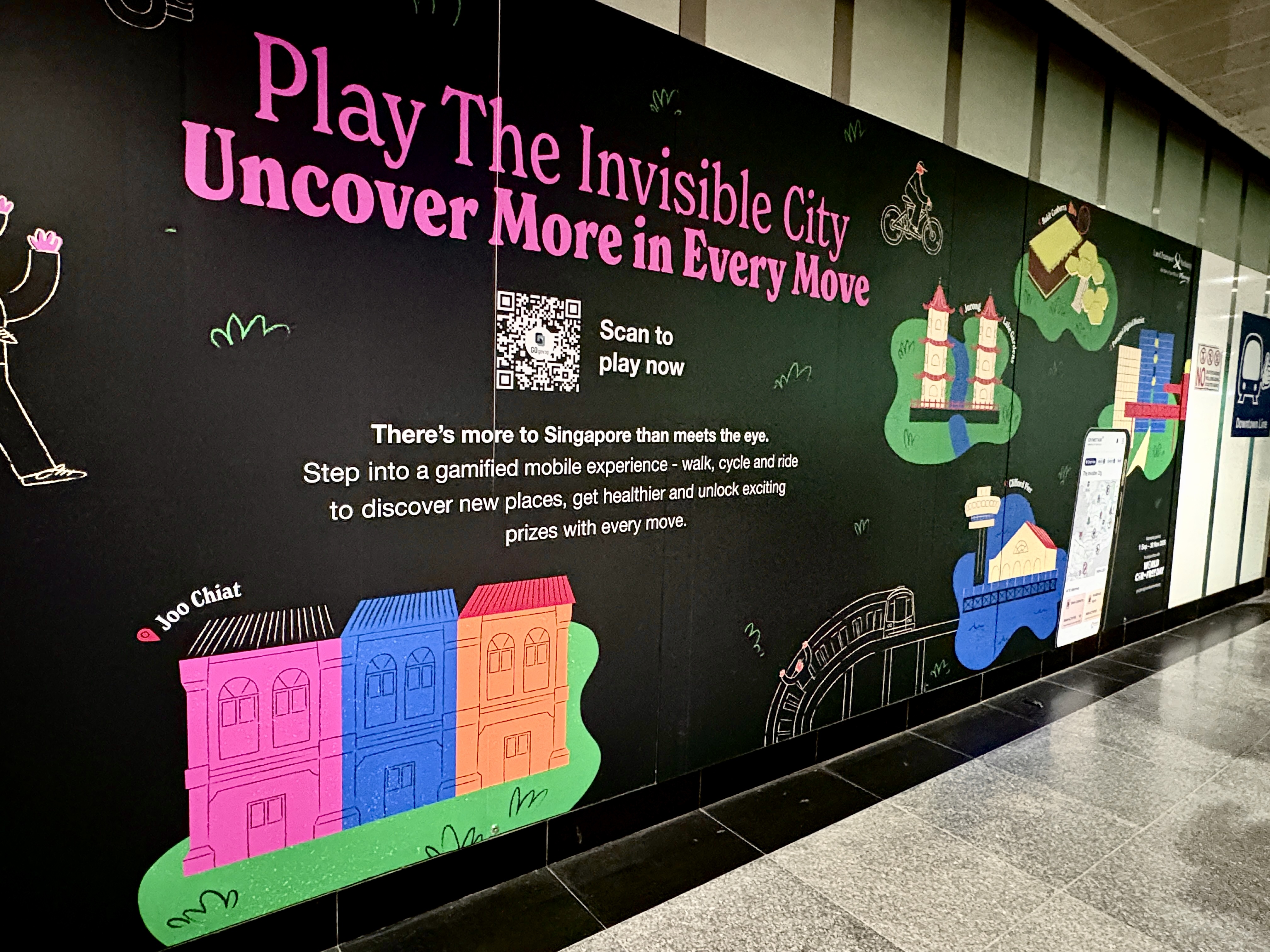
An ad for The Invisible City at Newton MRT station · Credit: Leadership for Cities
“Play the Invisible City. Uncover More in Every Move.”
The invitation appears on a wall at Newton MRT station, alongside colourful illustrations of Singapore’s neighbourhoods and a QR code. It is an arresting name for a place most of us think we know. What, exactly, is invisible about the city we move through every day?
The Land Transport Authority’s Invisible City Quest, developed with GovTech for World Car-Free Day 2026, invites people to walk, cycle and take public transport to destinations across Singapore. Through CrowdTaskSG, participants visit locations, take photographs, answer questions and share their thoughts. As they complete objectives, parts of a virtual map light up. Running from 1 September to 30 November, the quest offers rewards for exploring public spaces, community amenities, heritage sites and trails.
It gives people a reason to venture beyond their usual routes. A neighbourhood known only by its MRT stop becomes somewhere to explore; a place that would never have appeared on an errand list acquires a purpose.
Yet arriving at a place and coming to know it are two different things — more interesting possibilities begin only after the map has led someone there.
When a game brings people together
The rest of this piece is for Friends and Fellows.
Friends and Fellows read the whole Commons — essays, films and session recordings. Sign in with the email on your membership, or join from SGD 18.80 a year.