The Future Cities We're Dreaming Of
Why curious cities might be more optimistic cities
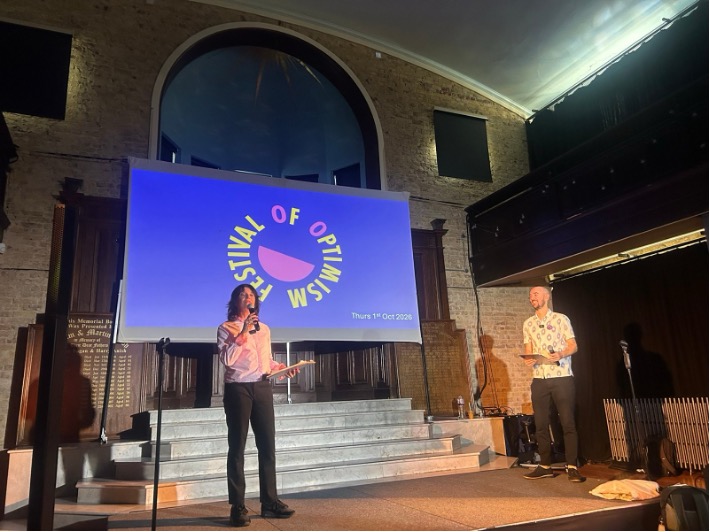
The inaugural Festival of Optimism, Margate, 1 October 2026. · Credit: Image by Clare Inkster
We talk a lot about the cities of the future.
Will they be greener? Smarter? More connected? More resilient? Will AI transform them entirely?
But something struck me at the inaugural Festival of Optimism in Margate last week.
Will our future cities bring more optimism?
Will they inspire us? Draw us in? Make us curious? Give us reasons to linger, explore, talk to strangers, notice things and imagine what else might be possible?
Because perhaps a city isn't just somewhere we live but also a giant playground for our imagination. And, given the challenges we face, wouldn’t that be wonderful?
What if the city helped us imagine differently?
Ridiculous ideas, taken seriously
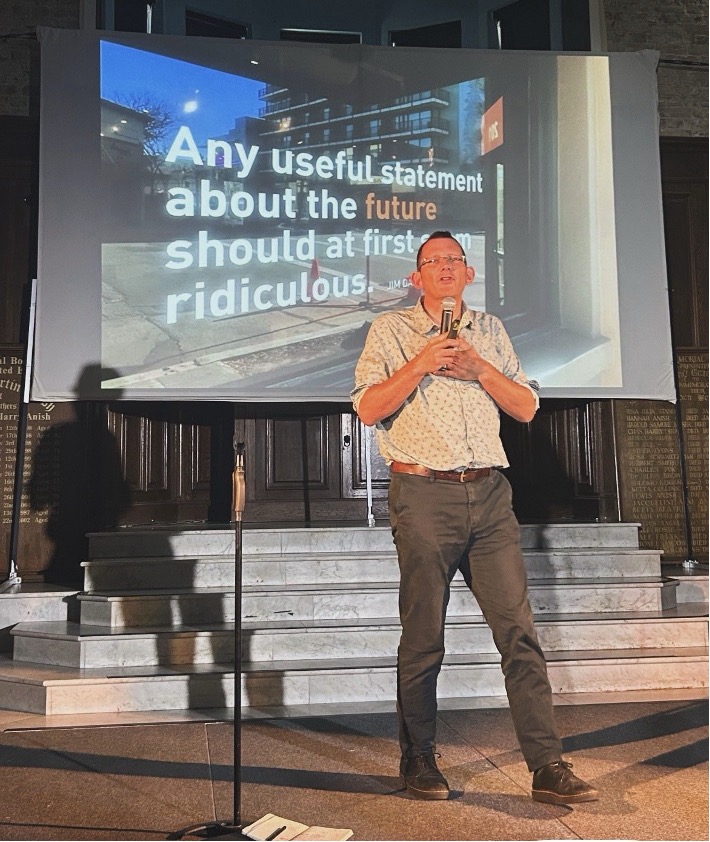
Rob Hopkins was with us in Margate and one of the things I love about his work is his willingness to embrace bold, audacious, even ridiculous ideas.
Rob, co-founder of the Transition movement and author of How to Fall in Love with the Future, has spent years asking people to imagine futures that initially sound completely unrealistic. His workshops include things like the “10 Ridiculous Ideas Challenge”, time travel exercises and “What If?” brainstorming. He often returns to the idea, borrowed from futurist Jim Dator, that “any useful statement about the future should at first appear ridiculous.”
It sounds playful and of course it is, but there is something serious underneath it. It strikes me that we have become very good at imagining what is likely and much less good at imagining what is possible.
And there is a big difference here.
We need our imagination more than ever
There is another reason I keep coming back to this.
We have an extraordinary human capacity to imagine things that don't yet exist. We can mentally travel into the future, simulate possibilities, combine things we've experienced in completely new ways and picture ourselves somewhere we've never been.
And yet there are some worrying signs that our creative thinking isn't necessarily flourishing.
In one study, psychologist Kyung Hee Kim analysed more than 272,000 participants across the normative datasets for the Torrance Tests of Creative Thinking. Her analysis found that creative-thinking scores had significantly declined since 1990, even as IQ scores increased. This was in 2011 so I wonder what the same research would show now.
I personally don't think that means we've somehow lost our creativity.
But it does make me wonder what happens when we spend more and more of our lives consuming information, following familiar patterns and asking machines to generate the next idea for us.
What happens if we stop exercising our imagination muscles?
And perhaps more importantly: what happens when we need that muscle most?
It strikes me that it is very difficult to create a different future if you can't imagine one.
The neuroscience is fascinating here too. Imagining the future isn't some fluffy extra activity our brains do when we're bored. Future imagination draws on some of the same neural systems involved in remembering the past. In effect, our brains use fragments of what we already know to construct possible futures.
Which means our experiences matter.
The more varied the things we see, notice, experience and encounter, the more material we have to play with.
And this is where I think cities get really interesting.
Looking twice
What if the city could feed our curiosity?
Think about the places that make you curious.
In Margate last week I was captivated by a dark tunnel that suddenly opens out to the bright, expansive blue ocean. Or in Ramsgate, a hidden mosaic staircase disappearing between two buildings. Or the community compositing that I’ve walked past numerous times but never really seen.
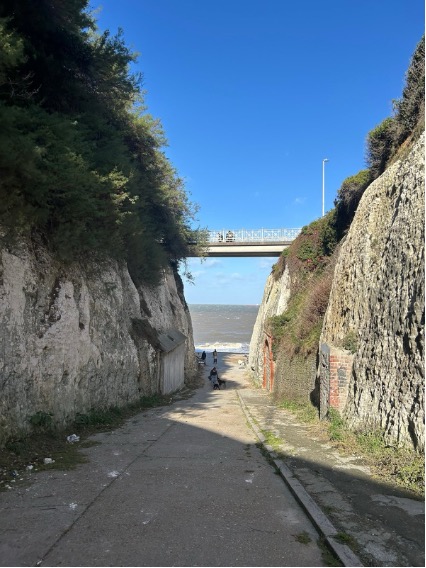
These tiny moments interrupt the predictable and make us look twice.
And looking twice is the beginning of curiosity.
There is growing evidence that deliberately paying attention to awe and wonder in everyday environments can change how we experience them. In one study, older adults who took weekly 15-minute “awe walks” for eight weeks reported more joy and prosocial positive emotions and showed greater reductions in daily distress than people taking ordinary walks.
Another body of research has found that experiences of awe can reduce our sense of self-focus and increase prosocial behaviour.
So perhaps we don't always need to escape the city to find wonder.
Perhaps we need to get better at noticing the wonder that is already there.
This is one reason I love ideas like awe walks offered on apps like The Humane Space or Street Wisdom. They turn an ordinary journey into a small experiment.
This reminds me of when Anupam Yog, a Singapore-based urbanist and creative strategist, first visited Thanet in 2023. Anupam invited us to take a walk through Ramsgate, but not simply to get from A to B. He encouraged us to slow down and really pay attention — to the spaces, the people, the details, the sounds, the smells and the things we might normally walk straight past. His work is rooted in the idea that the experience of a place matters just as much as its physical design.
It was a reminder that we can use our senses to experience a place differently. Instead of simply walking through a city, we can become curious about it:
What have I never noticed before?
What signs of optimism do I see?
What question could these streets help me answer?
Where does my attention want to go?
The city becomes less of a backdrop and more of a dialogue.
And when you start looking, you find things
This is where I think curiosity and optimism meet.
We sometimes talk about optimism as though it means believing everything will be OK – a kind of toxic positivity. My understanding of optimism is different. It involves deeply acknowledging the reality of a situation and then choosing to look for ways forward that leave things better than they were before.
That takes courage and strength and as the poster at the Festival of Optimism stated last week ‘Optimism is radical’.
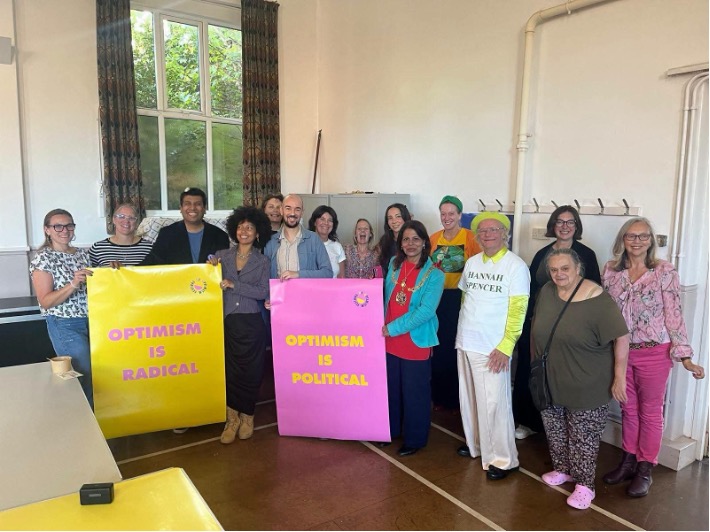
It is the willingness to believe that things could be different.
And then to get curious about how.
Curiosity gives optimism somewhere to go. It takes us from:
Wouldn't it be nice if… to: What if…? And then: What would happen if we tried?
There is evidence that imagining possible futures can do more than simply make us feel good. A systematic review and meta-analysis covering 123 studies and 5,685 participants found a statistically reliable positive effect of mental simulation on behaviour.
That doesn't mean that imagining something magically makes it happen.
But imagination can help us move from an abstract possibility towards something we can mentally rehearse, explore and begin to act upon.
And that feels particularly important when the challenges facing our cities can seem so enormous.
Places to practise possibility
Perhaps this is another way of thinking about the art of city making.
Not just how we design buildings, transport systems and public spaces, but how we create places that help people imagine.
Rob Hopkins has written about cities where birdsong replaces traffic noise, we have Civic Imagination Offices, free public transport, streets designed around people rather than cars, schools that nurture imagination and communities that create their own energy and food systems. These deliberately vivid stories stretch our sense of what could be possible and guess what…. somewhere in the world they already exist.
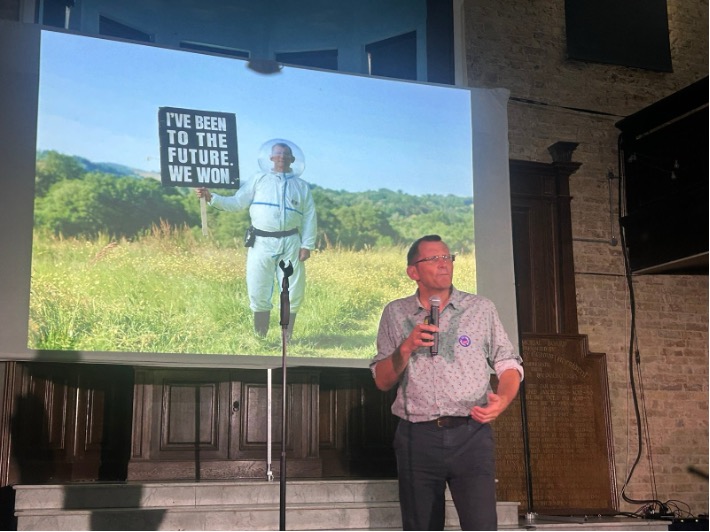
Perhaps optimism starts with a question
I don't know what the optimistic city of the future looks like.
And perhaps that's exactly as it should be.
Because the future isn't something we simply predict. It's something we imagine, test, shape and reshape.
We can notice what is already working. We can try something different. We can get things wrong. We can change our minds. We can look again.
That was one of my biggest takeaways from the Festival of Optimism in Margate: the future becomes more interesting when we stop asking what's realistic and start asking what's possible.
And perhaps that is what a truly optimistic city does.
It gives us somewhere to imagine.
Sources
Big smile, small self: Awe walks promote prosocial positive emotions in older adults
The rest of this piece is for Friends and Fellows.
Friends and Fellows read the whole Commons — essays, films and session recordings. Sign in with the email on your membership, or join from SGD 18.80 a year.