Financing Regenerative Citymaking
Eight working principles on the capital structure regeneration actually requires — patient seed, stewardship instruments, honest value capture, and anti-displacement as a financing covenant rather than a wish.
Every regenerative citymaking proposition we have seen in the last decade eventually arrives at the same wall: the money. Not the absence of money — there is more capital chasing “sustainable infrastructure” than at any point in the post-war era — but the wrong shape of it. Capital that wants quarterly returns being asked to underwrite twenty-year stewardship. Subsidy designed for single-asset projects being stretched across multi-block neighbourhoods. Philanthropy timed to a three-year programme cycle being asked to seed something that should outlast the funder.
This essay is a working note from inside the Placemaking & Legacy theme of The Art of Citymaking. It is an attempt to set down what we are increasingly convinced regenerative citymaking actually requires of its financiers — and why so much well-intentioned capital still produces districts that photograph well, hit their IRR, and quietly displace the people the brief was supposedly written for.
1. The mismatch is structural, not moral.
It is tempting to frame the financing problem as a problem of willingness: if only investors cared more, if only governments were braver, if only developers were less extractive. That framing is comforting and largely wrong. The mismatch between how capital is organised and how regeneration actually unfolds is structural — a matter of duration, governance and risk allocation — and no amount of ESG branding closes the gap.
Regenerative citymaking, properly understood, is a fifteen-to- twenty-five-year proposition. Its returns are partly financial, partly civic, partly ecological. Most of its upside accrues to parties who are not at the table when the first cheque is signed — future residents, future small businesses, the public realm itself. The standard project-finance instrument cannot price that. It was not designed to.
2. The three time-horizons.
A useful first move is to stop talking about “the capital stack” as a single object. In every regeneration we have worked alongside, three distinct time-horizons need three distinct kinds of money.
Patient seed capital — the first three to five years, before any built outcome. This is the period of feasibility, community covenanting, regulatory groundwork, demonstration projects. It is unbankable in the conventional sense. It is most honestly funded by a steward institution, a city, a foundation, or a coalition of long-view family offices who accept that they are buying optionality, not yield.
Construction and stabilisation capital — years five to twelve. This is the period that conventional real-estate finance understands, and is broadly well-served, provided the project has been structured carefully enough in the patient-seed phase to be legible to lenders. The trap here is that this is the only phase most financing conversations cover; the other two are assumed to take care of themselves.
Stewardship and reinvestment capital — years twelve to twenty-five and beyond. This is the period most regenerative projects underfund and many never reach. The buildings exist, the rents are flowing, the original sponsors have exited, and the question becomes: who maintains the public realm, who curates the ground-floor tenant mix, who reinvests surplus into the next phase of the neighbourhood rather than distributing it out? This is the phase that decides whether you have built a regeneration or a successful real-estate transaction.
3. The steward is the missing instrument.
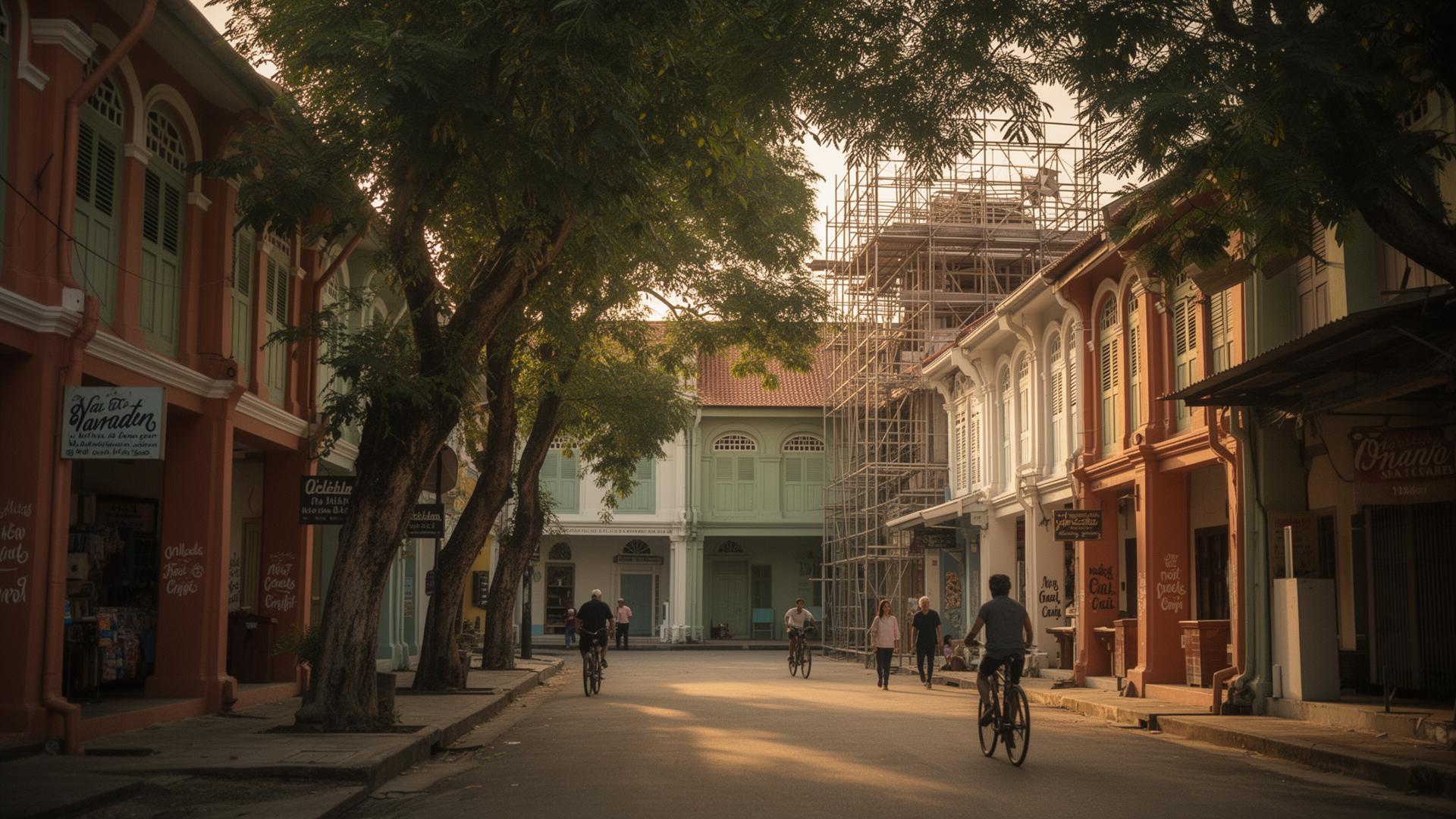
The most durable regenerations we keep returning to — Think City in George Town, HafenCity GmbH in Hamburg, the patient work of Bilbao Ría 2000, the slow re-stitching of central Lisbon — all share an institutional feature that is rarely discussed in financing circles: a steward with a multi-decade mandate, a balance sheet that can hold land and assets across cycles, and the authority to recycle surplus back into the neighbourhood rather than out to shareholders.
The steward is not a developer, not a regulator, and not a philanthropy. It is a hybrid instrument — sometimes a public corporation, sometimes a community land trust, sometimes a foundation-owned operating company — whose defining feature is the ability to be patient in a way that no listed entity and no five-year political cycle can be. Where stewards exist, regeneration compounds. Where they do not, regeneration stalls at the end of the construction phase and the neighbourhood begins, slowly, to be unwound by the next round of capital.
The implication for funders is that the most consequential cheque in a regenerative project is often not for a building. It is for the constitution, capitalisation and governance of the steward itself. That cheque is rarely written, because it is illegible to almost every funding instrument we have.
4. Value capture, honestly done.
Land-value capture — the idea that the public uplift created by a regeneration should partly fund the regeneration itself — is the most powerful financing mechanism the field has, and the most consistently mishandled. Done well (Hong Kong’s rail-plus- property model, Copenhagen’s Ørestad and By & Havn, Singapore’s long programme of state landholding) it allows public ambition to be financed by the future value the public investment itself creates. Done badly, it becomes a euphemism for upzoning the existing residents out of the picture and calling the proceeds a community benefit.
The discipline is honesty about who captures the value and on what terms. A value-capture instrument that returns surplus to a steward with an explicit anti-displacement mandate is a different instrument, morally and practically, from one that returns surplus to a general fund or, worse, to the equity sponsors who underwrote the rezoning. The accounting can look identical. The neighbourhoods will not.
5. Blended finance is mostly mis-blended.
The fashionable answer to the financing question is “blended finance” — concessional capital from a multilateral or foundation crowding in commercial capital at scale. In infrastructure and energy this works. In neighbourhood regeneration it has been markedly less successful, for a reason worth naming: the concessional layer is usually too small, too slow and too conditional to do the work the patient-seed phase actually requires, and the commercial layer arrives expecting a project that has already been de-risked in ways no concessional partner was funded to deliver.
The honest blended structure for regenerative citymaking looks different. It needs a meaningful first-loss tranche — closer to twenty-five per cent than five — held by a party with a civic mandate. It needs the commercial layer to accept lower returns across a longer horizon in exchange for a credible steward managing the asset on the other side. And it needs philanthropic capital used not to subsidise the commercial return but to fund the steward itself: the institution, not the asset.
6. Anti-displacement is a financing covenant, not a wish.
Every regeneration brief now includes language about “inclusive growth” and “avoiding displacement”. Almost none of those briefs translate that language into a binding financing covenant. They should. The mechanisms exist: rent caps tied to local median income, ground-floor leases reserved for independent operators below a turnover threshold, community right-of-first-refusal on freehold transfers, surplus recycling formulas that route value back into housing or small-business support rather than out to equity.
These mechanisms are rarely used because they are seen as a constraint on returns. They are better understood as a constraint on the kind of investor the project attracts. A regeneration structured with serious anti-displacement covenants will simply not appeal to capital that needed the displacement to make the numbers work — which is precisely the test the field needs.
7. The civic balance sheet is undervalued — and recoverable.
Most cities, particularly in Asia-Pacific, hold a civic balance sheet — land, buildings, rights, concessions — far larger than the balance sheet they conventionally finance against. Activating a modest fraction of that civic balance sheet through a competent steward can fund regeneration at a scale that no amount of grant capital or blended finance will match. The constraints are not financial; they are institutional and political. Building the institution to do it well is, again, the most consequential investment in the chain.
The corollary is uncomfortable for the international development community: most regenerative citymaking in the cities that matter most will not be financed by external concessional capital. It will be financed by domestic civic balance sheets, well stewarded. The useful international role is to help build the steward, share the instruments, and underwrite the cost of being patient — not to deploy capital that crowds out the local institutional development the work actually depends on.
8. What we are listening for on 17 June.
Across the Placemaking & Legacy theme at the Glass Dome on 17 June 2026 we will be listening for the practitioners who have actually built — or are actually building — the institutions this essay points at. The community land trusts in Asia that are quietly accumulating ground-floor freeholds. The patient family offices underwriting twenty-year neighbourhood stewards. The city agencies deploying value-capture honestly. The foundations writing the cheque for the institution, not the asset.
The financing story of regenerative citymaking is, finally, an institutional story. The instruments exist. The capital exists. The missing layer is the patient, civic, anti-displacement-minded institution that can hold the work across cycles — and the funders prepared to capitalise it before they capitalise anything else.
Cities are by far the most complex things humans make. They are the artefact of the thinking, behaviour and choices of generations of people. Financing them well is, in the end, a test of whether we are willing to be one of those generations.
— after Charles Landry, The Art of City Making
If your work sits inside this question — as a steward, investor, funder, policymaker, developer or resident — we would like you in the room. The Art of Citymaking, 17 June 2026, Glass Dome — Landmark of Good.