Adaptive Neighbourhoods: notes on regeneration
Seven working principles from inside the Adaptive Neighbourhoods theme — stewardship, editable rules, and anti-displacement as design constraint.
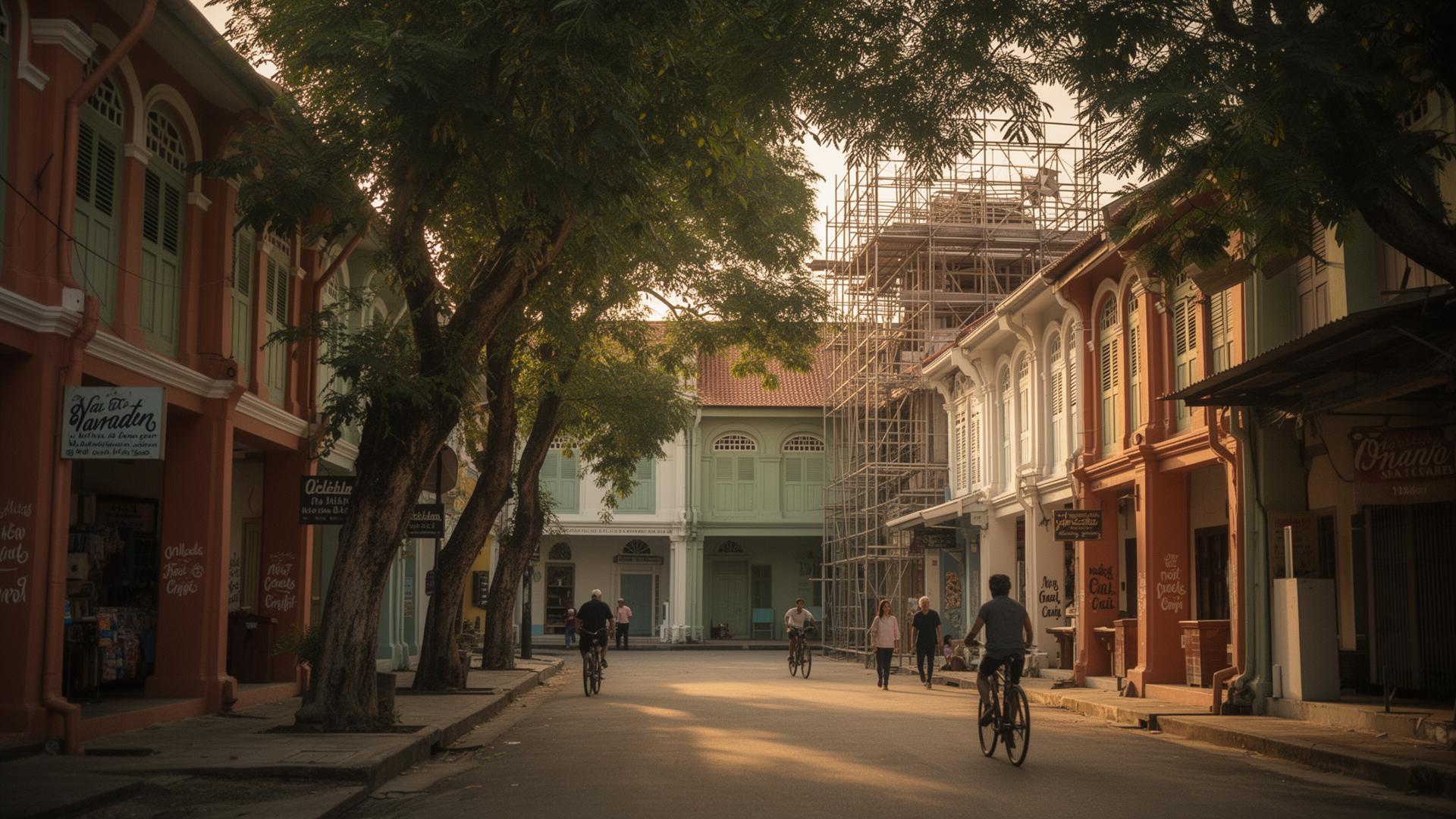
Urban regeneration has become one of the most overused — and least examined — words in the citymaking vocabulary. Every other masterplan promises to regenerate a waterfront, a high street, a post-industrial quarter. Fewer ask the prior question: regenerate for whom, on whose terms, and on what time-horizon?
This essay is a working note from inside the Adaptive Neighbourhoods theme of The Art of Citymaking. It is not a survey of best practice. It is an attempt to set down what we are increasingly convinced regeneration is — and isn’t — as we head into the Glass Dome on 17 June 2026.
1. Regeneration is not redevelopment.
The first confusion is the easiest to clear and the one most often muddled in practice. Redevelopment changes the physical fabric of a place. Regeneration changes its trajectory — economic, social, ecological, civic. The two overlap; they are not the same. A neighbourhood can be entirely rebuilt and not regenerated. A neighbourhood can be barely touched and meaningfully regenerated.
The implication for citymakers is uncomfortable: the unit of work is not the site, it is the system around the site. Tenure, livelihoods, small business ecology, water, microclimate, the way children get to school. A regeneration that does not move those indicators is, at best, a successful real-estate transaction.
2. The most durable regenerations are slow, stewarded, and partial.
The reference points the field keeps returning to — George Town and the work of Think City in Penang; HafenCity in Hamburg; the long, unglamorous recovery of Cheonggyecheon in Seoul; the patient re-stitching of central Lisbon and Porto — share two features that rarely make the press release.
First, they are stewarded by an institution with a 15-to-25-year mandate, not a project office on a five-year clock. Second, they proceed block by block, leaving deliberate slack in the plan so that the neighbourhood can absorb what arrives — a new use, a new resident, a climate event, a downturn. The opposite — a fully-resolved masterplan delivered on schedule — tends to produce a district that photographs well and ages badly.
3. Adaptive neighbourhoods are designed to be edited.
The shift from master-planned to adaptive is the shift the Adaptive Neighbourhoods theme tries to name. An adaptive neighbourhood is one whose ground floor can change tenant without a rezoning. Whose street can be closed to traffic on a Sunday without an emergency variance. Whose public realm can host a market, a protest and a wedding in the same week. The rules — planning, licensing, insurance, procurement — are written for change as the normal state, not the exception.
This is harder than it sounds. Most of the regulatory inheritance of the post-war city assumes that a building has a single use, a street has a single function, and a plan has an end-state. Adaptive regeneration begins by quietly unpicking those assumptions, usually long before any construction begins.
4. The neighbourhood is the right scale; the city is the wrong one.
Cities are too large a unit for regeneration as lived experience. Sites are too small a unit for the externalities to land. The neighbourhood — a few streets, a school catchment, a ten-minute walk — is the scale at which residents can recognise themselves in the plan, and at which the plan can be honest about its limits. It is also the scale at which most of the meaningful failures of the last thirty years have occurred: not at the scale of the masterplan, but at the scale of the block that was overlooked, the alley that was sealed off, the corner shop that was priced out.
5. Displacement is the question regeneration must answer first.
Every honest regeneration framework eventually arrives at the same question: who leaves, and on what terms? The literature is unambiguous — physical upgrading without an anti-displacement strategy reliably produces gentrification. The question is not whether to upgrade; it is whether the people who lived through the disinvestment are the people who experience the reinvestment.
The instruments are known: protected tenancies, community land trusts, inclusionary procurement, ground-floor retail at below-market rents, the deliberate retention of small and informal operators. They are unevenly used because they are politically expensive and slow to show on a balance sheet. They are also the difference between a regenerated neighbourhood and a replaced one.
6. Culture is infrastructure, not decoration.
The clearest lesson from the regenerations that have aged well is that culture was treated as load-bearing — the equivalent of a trunk road or a stormwater system — and not as a finishing layer. Artists in residence before the cranes. Independent operators in the ground floor before the chains. A programme that gives the neighbourhood a reason to be visited by its own residents, not only by tourists. Culture-as-decoration produces a quarter. Culture- as-infrastructure produces a neighbourhood.
7. Measure the boring things.
The metrics that predict whether a regeneration will hold are rarely the ones reported. Footfall after 8pm. The number of independent businesses still trading at year five. The share of residents who can name three neighbours. Tree canopy at pavement level. Time from a maintenance report to a repair. None of these photograph well. All of them correlate with neighbourhoods that are, twenty years on, still working.
What we are taking into the Glass Dome.
Across the Adaptive Neighbourhoods sessions on 17 June, three threads will run underneath the programme:
- Stewardship over delivery. The institutional form of the regeneration matters as much as the design of it.
- Editable rules. The plan is the easier deliverable; the regulatory grammar that lets the neighbourhood keep changing is the harder one.
- Anti-displacement as design constraint. Not a mitigation, not an annex — a brief.
We will return to this essay after the festival with what the room added, contested and refused. The conviction we are starting from is simple: the next generation of urban regeneration will be judged less by what it built, and more by who stayed.
“The redevelopment or revitalisation of a city is an art. It depends on the individual strengths of a place and the will of the leadership to bring about change.”
— Charles Landry, The Art of City Making
If your work sits inside this question — as a planner, developer, steward, operator, funder or resident — we would like you in the room. The Art of Citymaking, 17 June 2026, Glass Dome — Landmark of Good.