Helen Marriage: wonder as infrastructure
Seven years of negotiation, one three-storey elephant, and a million people in the street — the Anchor Resident of our inaugural Creators in Residence programme on why permission is the medium.
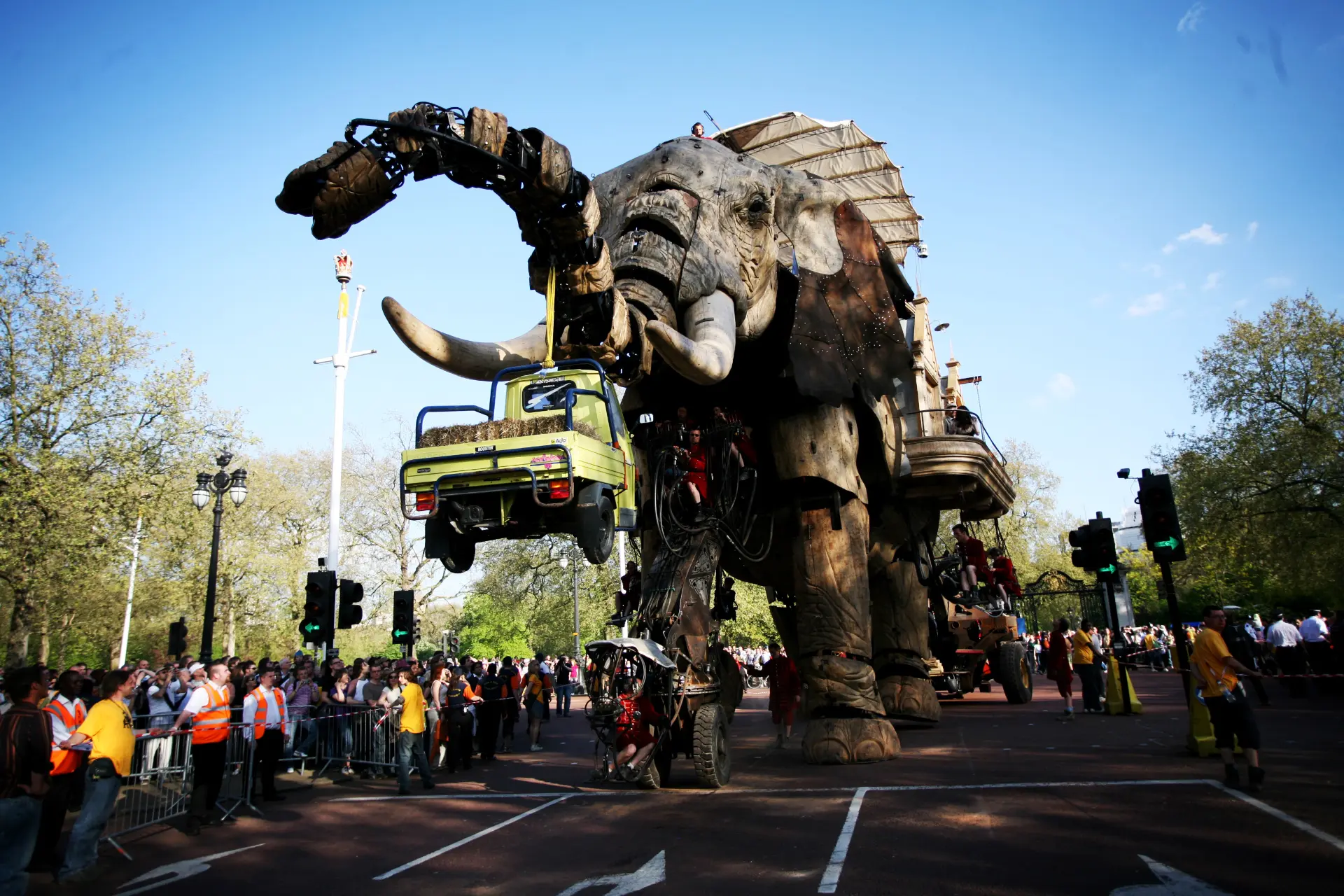
On 3 May 2006, the night before The Sultan’s Elephant arrived in London, Helen Marriage and Nicky Webb stood on the Mall watching taxis and joggers grind homeward, and asked each other the only question that mattered: do you think anyone will come? Getting to that evening had taken seven years of negotiation with public authorities, one of whom described the proposal as an infringement of the dignity of the ceremonial route. Over the four days that followed, a three-storey mechanical elephant built by the French company Royal de Luxe trundled and trumpeted through Westminster, closing roads as it went, and roughly a million people came out to follow it.
That is the story most people know, and it is the wrong one to stop at. The elephant is the image; the seven years are the argument. What Marriage does for a living is not spectacle — it is the patient, unglamorous work of persuading a city’s institutions to hand over their streets. Police, transport operators, borough councils, the mayor’s office, the parks: each has a legitimate reason to say no, and each has to be brought to yes before anything can be built.
Permission is the medium.
Artichoke, the company Marriage co-founded with Webb in 2005, has spent two decades repeating that manoeuvre at scale. La Princesse, a fifty-foot mechanical spider, moved through Liverpool for its year as European Capital of Culture in 2008. Lumiere began in Durham and became a biennial fixture, then produced Lumiere London in January 2016 — four nights across Mayfair, Piccadilly, Regent Street, Trafalgar Square and King’s Cross, staged deliberately in the bleakest week of the year. In 2018, Processions put thousands of women in the green, white and violet of the suffragettes onto the streets of Belfast, Cardiff, Edinburgh and London at once.
Read as a body of work, the throughline is not the artwork but the audience’s change of status. As Marriage has put it, a million-strong crowd that turned up simply to watch became participants in a joyous occupation of the streets. The city stops being a machine for moving people around and becomes, for a few days, a place people are in together. That is a civic outcome achieved by cultural means — and it is why we invited her to argue for wonder as a form of infrastructure rather than a form of decoration.
Wonder as infrastructure.
Marriage was the Anchor Resident of the inaugural Creators in Residence programme, and her keynote closed the festival’s afternoon strand What Is a City For? at the Glass Dome on 17 June 2026, opened by Saurabh Mangla. Her session — Wonder as infrastructure — took the line from the Sultan’s Elephant to Lumiere and asked what happens when a city stops, looks up, and remembers it is more than a traffic system.
The claim has an edge to it that is easy to miss in a festival setting. Writing in 2020, when mass gatherings had been suspended, Marriage argued that culture mediated through a screen can never replace the feeling of being part of something big, and that a public taught to fear congregation loses something it will not automatically get back. Wonder as infrastructure is not a metaphor about atmosphere. It is a claim that the capacity to assemble in public — and the institutional machinery that grants permission for it — is civic equipment, and that equipment can be allowed to rust.
Marriage is a Loeb Fellow of the Harvard Graduate School of Design, and has worked at the margins of theatre, art and celebration throughout her career, including years running the Salisbury Festival and work with LIFT, the London International Festival of Theatre. The recurring interest across all of it is the same one that brought her to Singapore: making the arts speak to people who have no particular interest in the arts, in the places where they already are.
Image: The Sultan’s Elephant, London, 2006. Courtesy Artichoke.