What Makes a Mall Feel Local?
As brands from China expand, concerns about neighbourhood character raise a larger question about belonging.
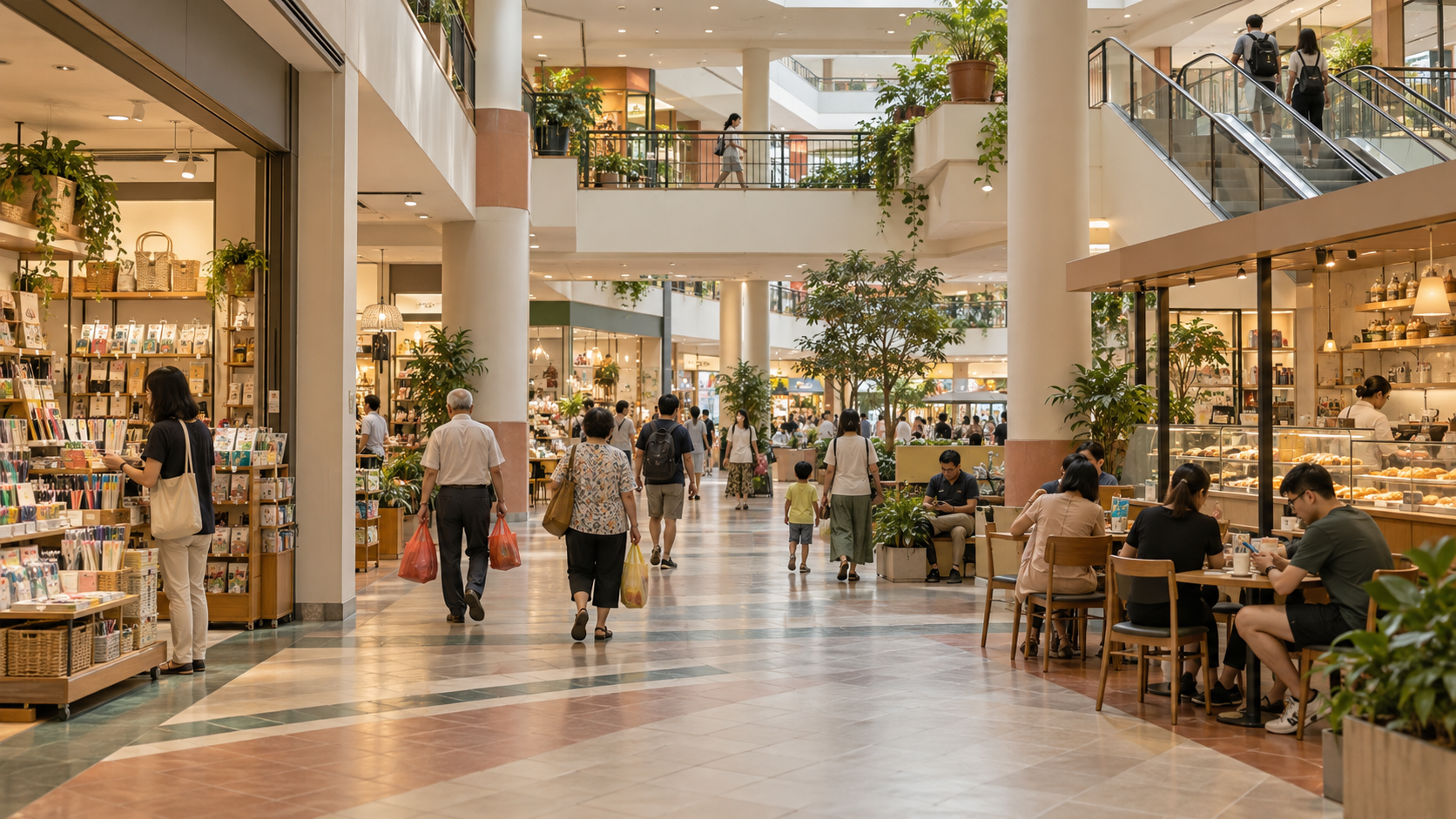
Credit: Illustration of a shopping mall, created for Leadership for Cities
Are Singapore’s malls losing their local flavour as more brands from China move in?
The concern has surfaced beyond social-media headlines. The Straits Times has reported residents’ concerns about diminishing retail variety and halal dining options following the mall’s change of ownership. In January 2026, MP David Hoe asked in Parliament how a tenant mix concentrated on one overseas market might affect inclusion and social cohesion. The government’s reply emphasised commercial decisions, consumer preferences, and economic conditions.
Online, the feeling can be more personal. One Lemon8 contributor described neighbourhood shopping as feeling “a little less Singaporean”, while openly enjoying brands like Chagee, Luckin Coffee and Mixue. The writer missed familiar shops but explicitly stopped short of claiming that Chinese brands had directly displaced them.
While these accounts are not a representative survey of public opinion, they do reveal a tension: welcoming the new arrivals can coexist with unease about what a familiar place is becoming.
A recent Mothership investigation by Teh Aik Hui adds perspective. Comparing directories from 26 malls in 2023 and 2026, it found that brands originating in China grew from 2.46 per cent to 4.97 per cent of tenants. Singaporean brands remained at roughly 66 per cent.
The sample does not cover every mall, and tenant counts do not measure floor area or visibility. Nor can an unchanged aggregate share establish whether particular independent shops have survived. The figures challenge a sweeping story of replacement without settling questions about individual neighbourhoods.
What, then, makes a mall feel local?
Becoming familiar
“Local” can describe where a business began, who owns it, or how closely it serves a neighbourhood. These meanings overlap, but they are not interchangeable. A homegrown chain can offer much of the same experience across different locations. A foreign brand can become inseparable from a community’s memories of a particular place.
Thomson Plaza offers a useful counterpoint. So closely was it associated with its Japanese department store that residents called the mall “Thomson Yaohan”, a nickname recorded by the National Heritage Board. A business from elsewhere became a local landmark. The attachment was formed here, through people’s visits and the experiences they associated with them.
In a DBS account of Thomson Plaza’s development, the mall is remembered for children’s weekend lessons, family grocery runs, and long-time businesses such as Chiu Piano and Aquapet. Ordinary activities, repeated over years, became part of neighbourhood life.
A shop directory records what is available, but not the relationships and routines that develop around it: family outings, an anticipated treat, a regular meeting point. When people remember a mall affectionately, they may be remembering the life that happened around its shops as much as the shops themselves.
The rest of this piece is for Friends and Fellows.
Friends and Fellows read the whole Commons — essays, films and session recordings. Sign in with the email on your membership, or join from SGD 18.80 a year.