The Trains That Carried a City
What the retirement of Singapore’s first MRT trains reveals about memory, renewal and the everyday life of a city.
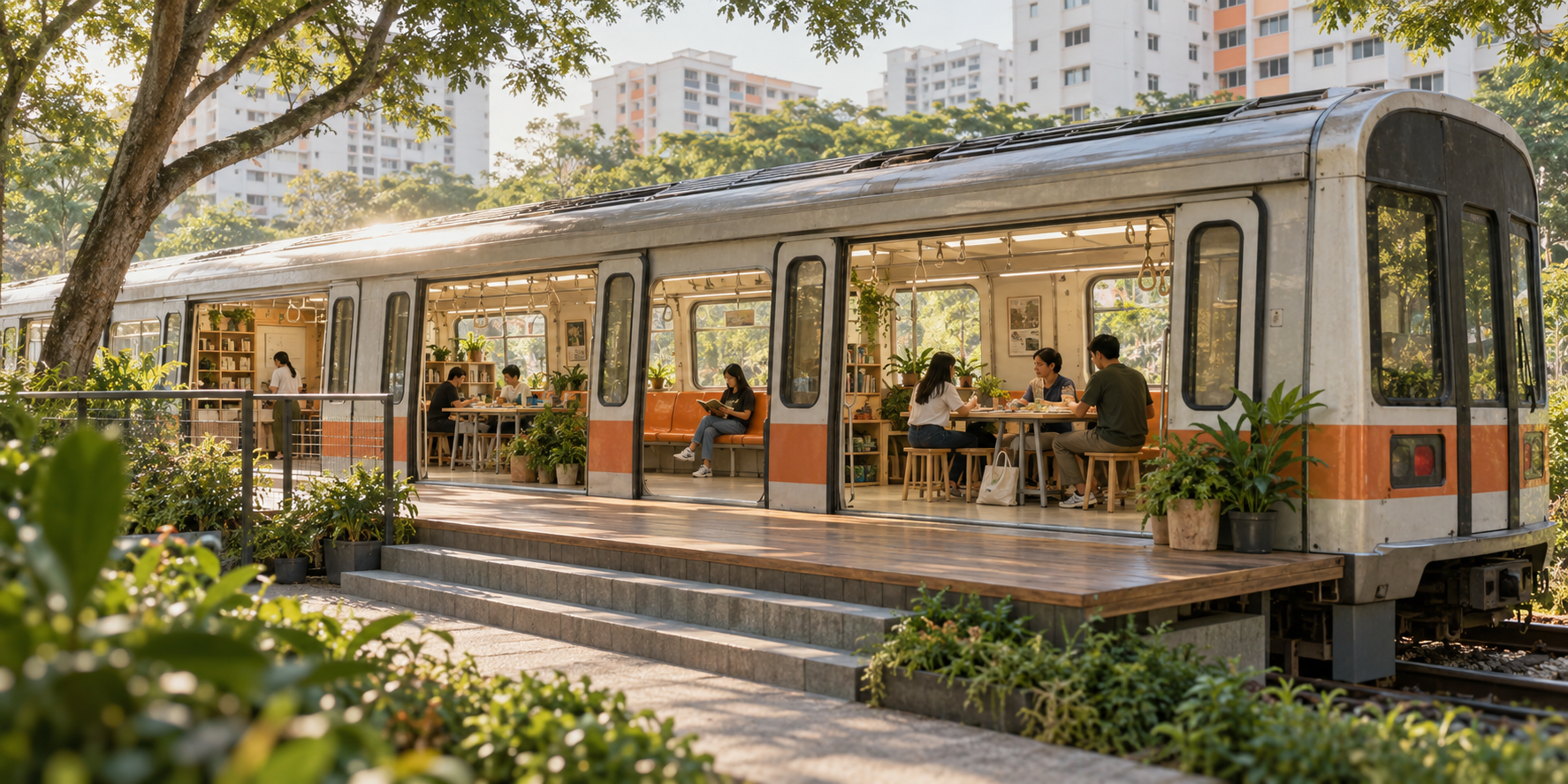
Credit: Illustration of a repurposed MRT train, created for Leadership for Cities
On 25 September 2026, the final batch of Singapore’s first-generation MRT trains was sent to be scrapped. Their last passenger journeys had taken place a year earlier. By then, many commuters had already become accustomed to the newer trains on the North-South and East-West lines. The old fleet had slipped out of daily life before its physical end arrived.
Trains cannot run indefinitely. They need maintenance, and eventually replacement, if a public transport system is to remain safe and dependable. Yet the sight of a carriage being dismantled may still give us pause. What is being taken apart is not only a machine. For decades, these trains were one of the places in which Singaporeans lived small portions of their days.
We rarely think of a train as a place. We enter, find a spot, count the stops and leave. But consider how much of a life can pass inside one: the journey to a first job, the trip home after a late shift, a parent bringing a child to school, an elderly passenger learning to navigate a changing city. A carriage holds all these moments without knowing their significance. Most are unremarkable at the time, which is precisely why they tell us something about everyday life.
Singapore’s MRT opened in November 1987 with a short stretch between Yio Chu Kang and Toa Payoh. It was the beginning of a system that would grow alongside the housing estates, workplaces and other destinations it connected. The first-generation trains were not merely witnesses to that growth. They helped make it possible. A rail network changes what feels near, where people can work, whom they can visit and how they imagine the shape of their city. The National Heritage Board’s account of the MRT traces its long planning history; the everyday consequences of that planning unfolded journey by journey.
That is the citymaking story beneath the retirement of a train. Cities are not made only when a new building opens or a master plan is unveiled. They are also made through the repeated act of getting somewhere. The route between home and work becomes familiar; a station becomes a meeting point; a line on a map becomes a connection between people who might otherwise have remained far apart. Over time, infrastructure becomes part of how a city is inhabited.
The rest of this piece is for Friends and Fellows.
Friends and Fellows read the whole Commons — essays, films and session recordings. Sign in with the email on your membership, or join from SGD 18.80 a year.