Being versus doing: unlocking new dimensions of liveability
If liveability 1.0 measured the environment in service of human doing, liveability 2.0 must be concerned with the felt impact of that environment on human being — the conscious city.
An adapted version of an opinion piece first published in the Centre for Liveable Cities Knowledge Hub, Liveability in Action.
What if the city was reimagined as a collection of nudges that supported healthy behaviours? If that city possessed intelligence, artificial or natural, how would it enable humans to make wiser choices — to prevent the onset of disease, increase longevity and improve healthspan?
We now know certain evidence-based realities of what it takes to be a sustainable and liveable city on a rapidly urbanising planet with finite resources: liveable density, compact urban form, accessible public transport with an emphasis on walkability, well-connected open spaces, and a vibrant culture and economy, delivered through effective administration and governance. If liveability 1.0 was measured by the quality and performance of the physical, social and economic environment in service of human doing — living, learning, working and playing — liveability 2.0 must be concerned with the felt impact of that environment on human being. The performance of such an environment would include the quality of inhabitants' rest and opportunities for renewal; their emotional, mental and social health; and their levels of attention and awareness. Cognitive engagement and response to public spaces that make humans feel better is the evidence of an intentional, high-quality, liveable urban environment — a conscious city.
Being versus doing.
Urban life keeps us in cycles of continuous physical and mental activity, with productivity and achievement as the default measures of success, urging us to constantly strive for results. The pursuit of "more" fuels a perpetual sense of insufficiency — a sense of never having or being enough. The impacts of a doing-oriented world are chronic tension, depletion, and the tendency to operate on autopilot, mindlessly reacting to life rather than fully engaging with it.
Liveability 2.0 calls for a fundamental shift — perhaps even an overhaul — of this conditioned mode of urban living, by reorienting the way we move through our spaces and inhabit the city. The human being understands the necessity of slowing down and recognises the value of stillness and rest. Success is no longer measured only by accumulation or quantifiable achievements, but by the quality of experiences and their impact on health and wellbeing. Instead of asking how much we have accomplished, we begin to reflect on how nourished we feel.
Shifting urbanisms.
I call this paradigm conscious and regenerative urbanism. It brings together ancient wisdom and modern science by broadening the scope of placemaking. It infuses insights gained from mindfulness and neuroscience into the practice of urban design, real estate and finance. Through this lens, placemaking is an emergent concept that acknowledges the city as a complex system. Harnessing that system requires counter-intuitive ideas — and more dynamic approaches to delivering liveability than the ones we inherited.
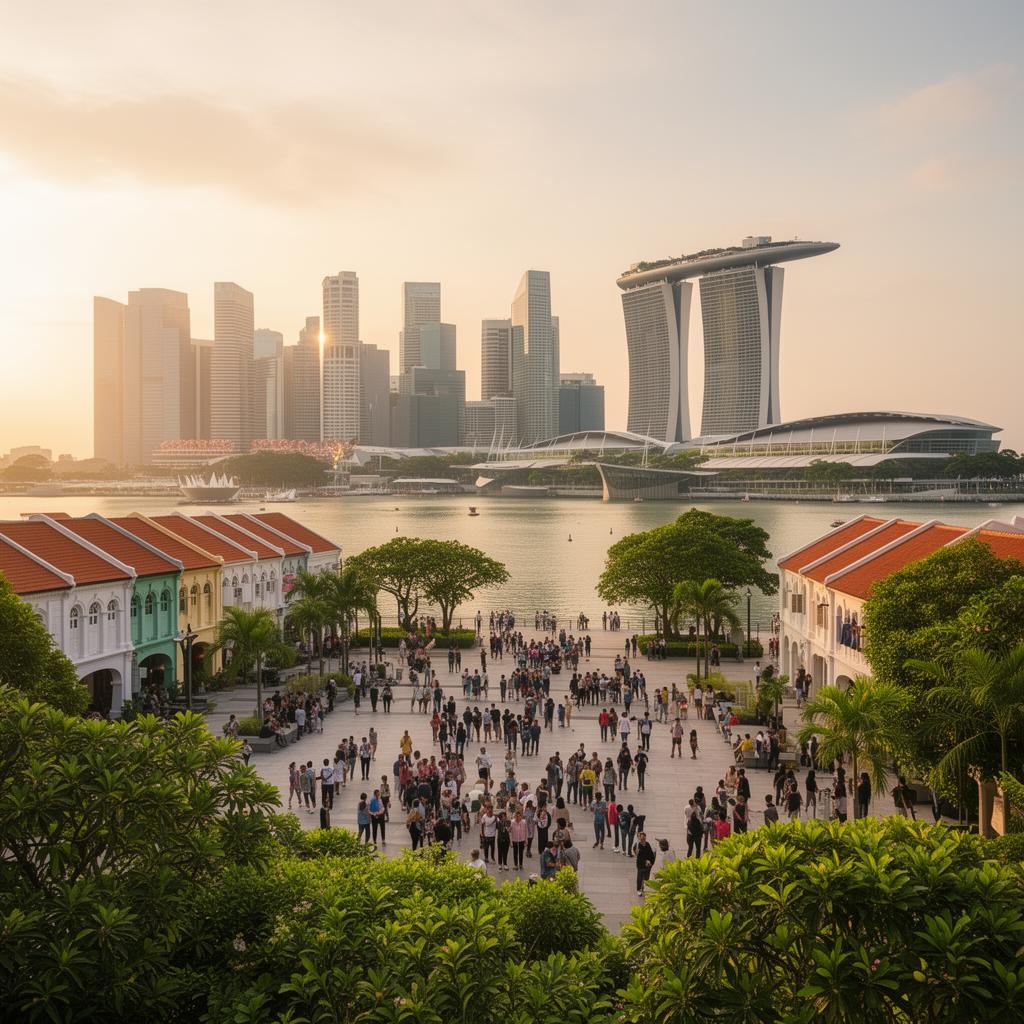
Singapore's evolution from a City in a Garden into a City in Nature is one example. The state has prioritised the value of natural capital as it continues to transform its urban landscape to be purpose-fit for a variety of life — this happening concurrently with the expansion and regeneration of public housing estates, new towns and private developments curated as mixed-use, mixed-income and mixed-generation neighbourhoods. Connectivity between humans and with nature, alongside a diverse mobility network, produces economies of scope as a potential source of competitive advantage. There is an inherent wisdom to this kind of development, which balances doing with being to produce conditions for liveability 2.0 at scale.
The Big Sit: reimagining third space.
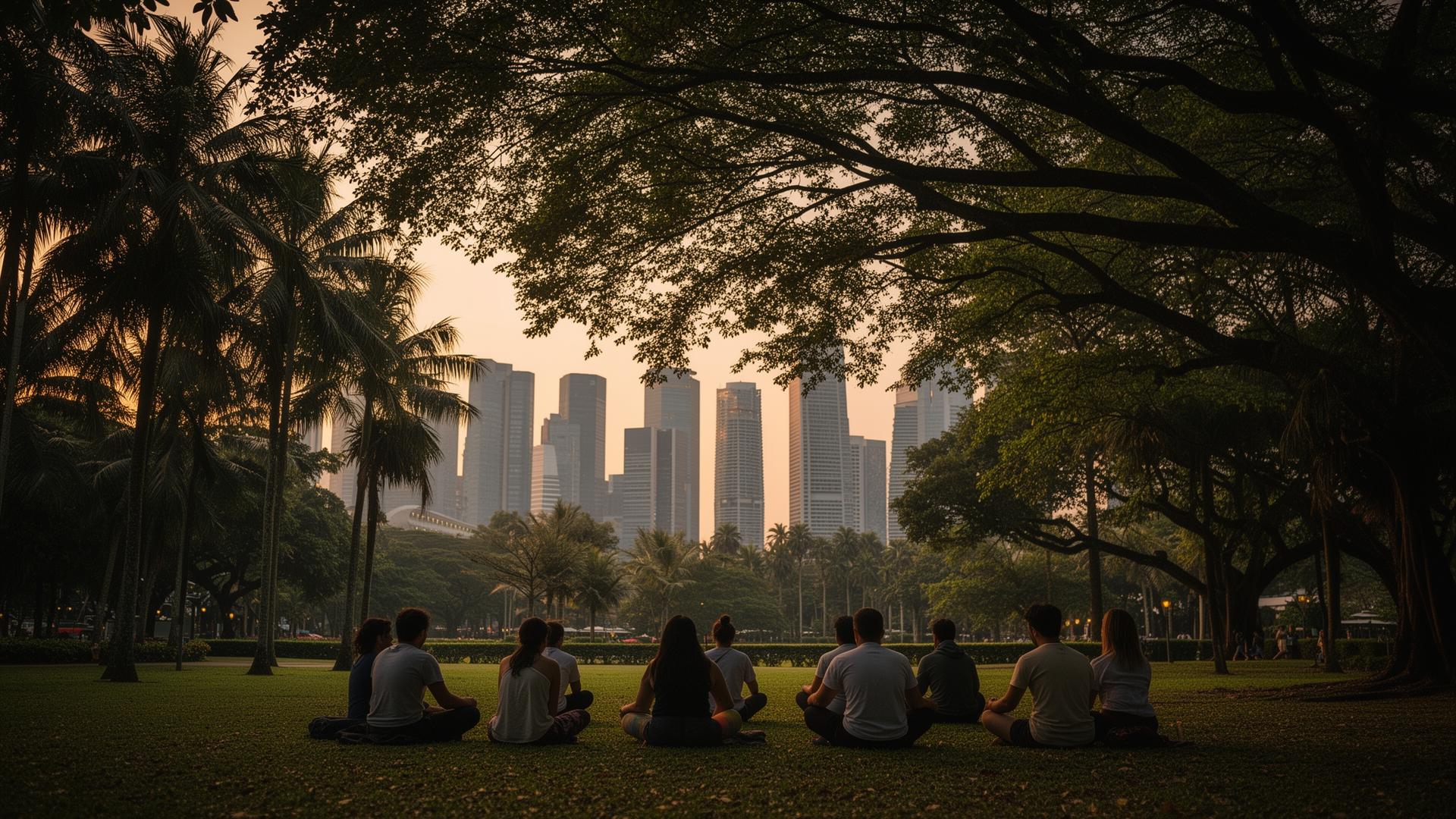
The Big Sit (TBS) is a social experiment that began during the pandemic to explore how we can change our relationship with ourselves, and with our environment. By merely sitting in a public space in the Central Business District, mindfully and intentionally, we observe how our internal experiential landscape is impacted by our surroundings. Through this simple, surprisingly difficult act, we grow in patience and tolerance, acquiring new skills to navigate urban life responsively rather than reactively. As a formal yet organic intervention, TBS creatively enables a new dimension of being within the CBD, in contrast to constantly doing or moving within it.
The pandemic introduced new types of social behaviours. Lockdowns and physical distancing became a universal urban response; people everywhere were forced to re-evaluate how to use private space — the home — which in turn changed the perception and utility of shared space — the office. At the same time, the value and role of parks and other types of third space came into sharp focus. The third space gives people context, even meaning and purpose. Change the use of a street — restrict vehicle access, for example — and the way users perceive it shifts; the buildings respond over time. Zoom out to the city, and the role of open space is the same at larger scale: green spaces, parks and plazas make a city, give it identity, and foster social connection.
While many people spend much of their time in personal bubbles, it is the time spent outdoors and in communal spaces — parks, markets, theatres, museums, or merely sitting in public — that often makes life more meaningful, purposeful and happy. The brief time spent together being in community, intentionally, helps transform loneliness into aloneness — fostering the recognition that responding to urban social isolation may involve acquiring new skills to just be in the city, on your own, and to know there is a place for you.
Compassion made possible.
Whether we consider a global city-state like Singapore, or human habitats of different scales and complexities, it is the relationship with our nature that is the key parameter to explore for liveability 2.0. Much as Singapore has evolved from a City in a Garden into a City in Nature, perhaps its socio-economic and cultural vision is similarly shifting to embrace an idea of Compassion Made Possible. Such a transformation entails the production of place more than space — a concept particularly fitting for a nation with land and resource constraints. It is informed by the desire to be distinctive, yet guided by a pragmatic understanding of the limitations of traditional economic growth, and an invitation to deeper engagement with new frontiers of creativity and innovation.
As we move into a post-pandemic world, where context is rapidly changing, how, when and where do we measure liveability? Indeed, what constitutes liveability itself?
Liveability 2.0 should acknowledge that a meaningful premise for a measurement system could be to understand the value of a pause in the pursuit of happiness in favour of just being happy. Such a shift would entail a significant recalibration of the experience of being in a city, where rest and renewal are normalised and life can flourish.
Rather than the stability and expanse of a city's infrastructure — increasingly vulnerable to climate risk regardless of economic strength — is it more pertinent to measure the response-ability of the city's social fabric to enable a more compact form and greater community wellbeing? As society transitions into a new age of AI, would a city that values serendipity over predictability be more attractive to high-quality talent seeking to produce, make, design, create and invent?
Anupam Yog is Festival Director & Founder, Leadership for Cities. This essay was first published in the Centre for Liveable Cities Knowledge Hub and is republished here in adapted form.