districtBE: before the doing, being
On the edge of Jaipur, a living district inside Dhun is rehearsing a slower civilisation — ecology, community and attention held on a single ground.

On the edge of Jaipur, in a stretch of grassland that ends where the city's appetite begins, a small experiment has quietly been taking shape. It is called districtBE — a living district within the wider regenerative habitat known as Dhun — and it is, in its own words, a prototype for another rhythm of civilization, where land, life and public ritual return into a single, slower conversation.
It is not a retreat from modern life. It is a working prototype of another one.
Before the doing, being.
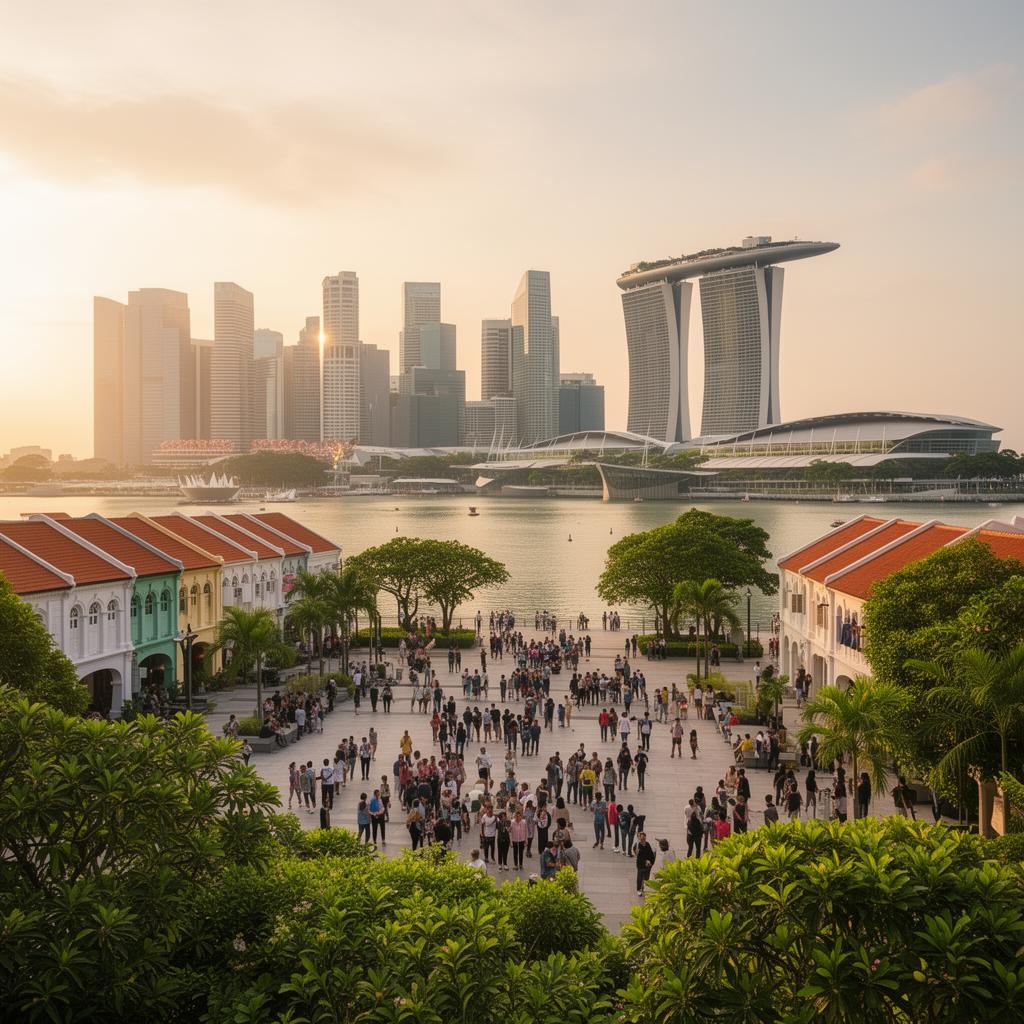
The opening line of districtbe.org is a thesis as much as a greeting: Before the doing, being. It pairs, perhaps deliberately, with the older Singapore op-ed we republished earlier this week. The two pieces are arguing the same thing from opposite ends of the urban gradient: that the conditions for presence — wetlands, groves, walkable paths, public meals, stars uninterrupted — are not amenities, they are infrastructure. They are the quiet infrastructure a humane modernity depends on.
The shape of a day.
districtBE describes itself less as a programme than as a pace. A day is observed from inside the landscape — dawn walks through grasslands, slow morning work in the kitchen garden, a long shared meal under shade, afternoon reading and rest, evening music and food cooked over fire, and a night in which sleep arrives without persuasion. The schedule is set by light, weather, and the small movements of the land. It is the village clock that designers and planners have been trying, mostly badly, to reproduce inside denser contexts for a generation.
Three pillars, one ground.
The district organises itself around three commitments — deliberately the same three any conscious city must hold together:
- Ecology — wetlands, grasslands and grazing systems repaired over years rather than seasons.
- Community — intergenerational, human-scale, rooted in shared meals and public life.
- Consciousness — recovering attention through landscape, rhythm and quiet practice.
The field notes published from the site read like a quiet ledger of whether it is working: the wetland held water for eighteen days, longer than last year by four; herons returned within a week. Three baya weaver nests near the eastern grove; we have stopped clearing the thorn scrub beneath them. Without announcement, people leave their houses near sunset; they meet on the path between the orchard and the pond. Nobody calls it anything. It happens. These are the small metrics that no liveability index has yet learned to capture — and the reason, exactly, that the Conscious Cities Index (an XDG Labs initiative) was instrumented in the first place.
Laboratory, observatory, conservatory.
districtBE is staged in three arcs. Stage 01 is the Laboratory — the current phase — testing regenerative systems, communities and habitat ideas in lived practice. Stage 02 is the Observatory — interdisciplinary learning, leadership networks, collective intelligence. Stage 03 is the Conservatory — a long-horizon institution for stewardship, learning and cultural continuity. The arc, like everything else on the site, is measured in years and seasons rather than quarters.
Inside a wider ecosystem.
districtBE is one layer of Dhun — a regenerative habitat exploring ecology, culture, consciousness and community as a single conversation. The wider network includes XDG Labs (observatory, intelligence and habitat systems), weareMIXD (experience design, participation, cultural activation), and the Leadership for Cities network (cross-city dialogue and leadership). The making, the site notes, happens elsewhere in Dhun. Here, the conditions for it.
Why this matters for The Art of Citymaking.
Jaipur is one of the twelve cities in the v1 Conscious Cities Index — and one of four Big Sit anchor cities. It scores high on practice (71), inheriting a habitat of pause-points, palace gardens and heritage geometry. The stewardship score (54) is the gap; the tending is partial. districtBE is, in a small way, one answer to what closing that gap looks like in lived practice: a place where ecology and attention and public life are not three separate agendas but the same agenda, held on a single ground.
We will return to this terrain — districts, slow infrastructure, intergenerational stewardship — in the Adaptive Neighbourhoods track at the Glass Dome on 17 June. For now, the recommendation is simple: come slowly; be enchanted.