We Stayed for the Music and Credits
On The Violinist and the value of lingering.
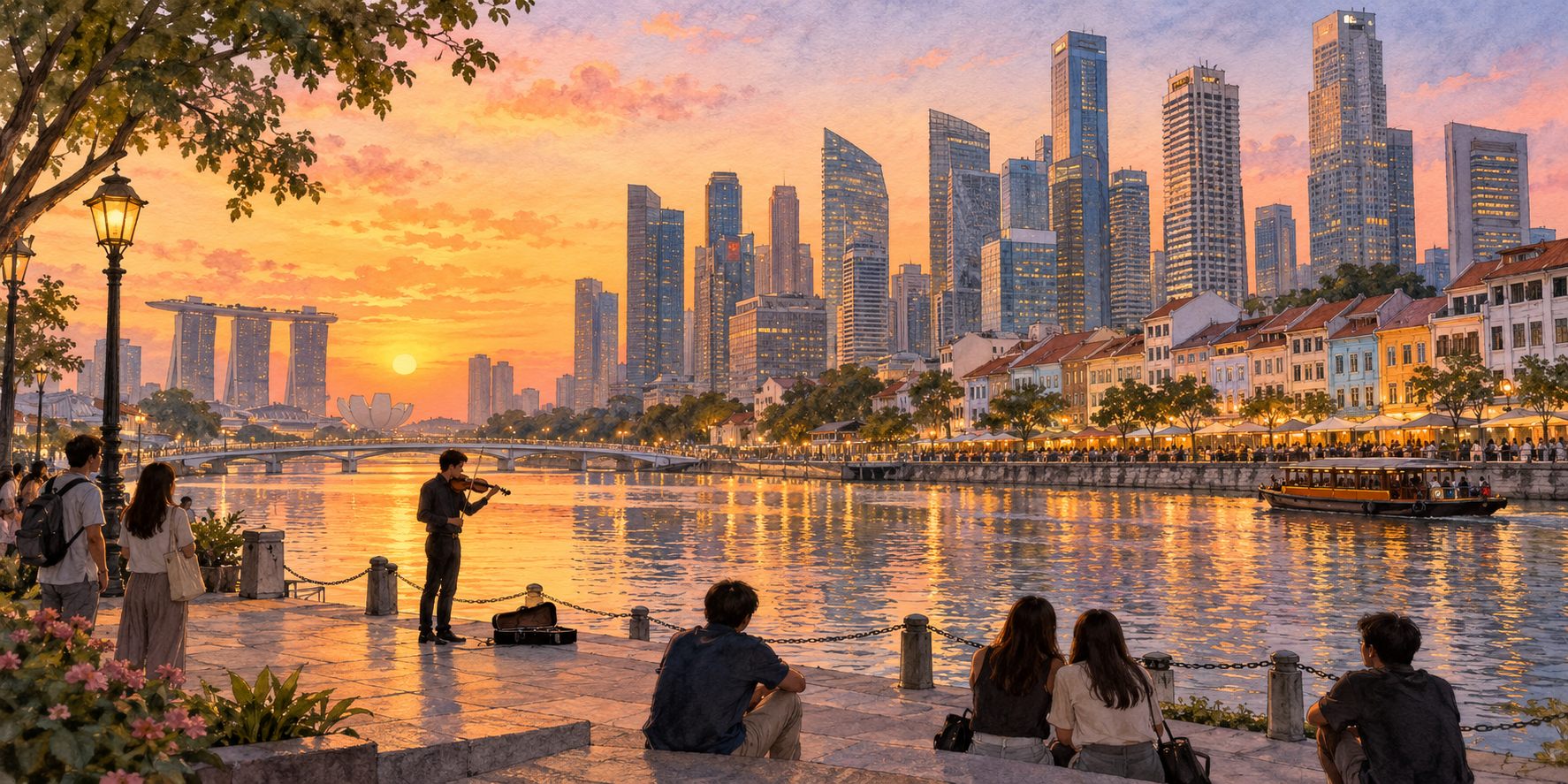
Credit: An imagined riverside performance, created for Leadership for Cities
A riverbank can become a concert hall when someone begins to play and others pause to listen. A cinema can become more than a place to watch a film when strangers choose to remain together after the story ends. These changes do not require new infrastructure. They happen when people give a place — and one another — their time and attention.
We speak readily about the spaces a city provides, and with good reason. But a city’s cultural life also depends on how people use those spaces. Can we share music without a formal stage, or find comfort in a neighbour’s artistic expression? Can we stay with an experience, and with each other, a little longer without being hurried towards the next thing?
I found myself thinking about those questions after watching The Violinist, the Singapore-led animated feature now screening in cinemas. When the film ended, the audience applauded. The orchestral score continued beneath the rolling credits. There was no extra scene waiting at the end, yet for about ten minutes, no one around me seemed in a rush to leave. We stayed through the final credit, and the cinema staff eventually had to ask us to leave.
The intelligence in a drawn hand
During the film, I kept returning to the violinists’ fingers. They moved along the strings in time with the music, sometimes in passages so intricate that I wondered how many times an artist had drawn and redrawn those hands. I never found myself waiting for the next scene — I was captivated by the care visible throughout.
That precision came from work many viewers may never think to look for. Co-directors Ervin Han and Raúl García have described the challenge of making the playing credible; Han said the team spent about 18 months on the violin animation. They also had to balance historical detail against what García calls “pencil mileage”: every extra line on a moving character has to be drawn again and again.
That is where I see analog intelligence at work. It takes a trained eye and ear to make a violinist’s fingers follow the music — and knowledge of place to know when a beautifully drawn street still does not feel like Singapore. Analog intelligence need not exclude digital tools. The Violinist combines hand-drawn 2D animation with computer graphics. Those tools carry the artists’ judgments about sound, movement and place into the finished image.
To draw that city, the Singapore team researched buildings, objects and everyday life, then prepared references for collaborators overseas. Han has recounted how an early layout of 1920s Chinatown came back looking like Paris. The anecdote is amusing, but it reveals something deeper about cultural knowledge. Architecture alone does not tell an artist who used a street, how people moved through it, or what made it familiar to those who lived there.
The film grew from Han’s 2015 short The Violin into a feature made over more than a decade with artists and partners across several countries. That long journey reminds us that patience in culture is not simply a personal virtue. Artists need time, skilled collaborators and the means to keep working. A city that wants its stories told must make room for the people who can tell them.
The rest of this piece is for Friends and Fellows.
Friends and Fellows read the whole Commons — essays, films and session recordings. Sign in with the email on your membership, or join from SGD 18.80 a year.